
Our Take: Nebius Stock Sinks After a Q3 Beat as Capex Soars to $27B
By Tech & Money Press · Our Take on Nebius Q3 2026 earnings · November 12, 2026
One day after the neocloud rally, Nebius gave a lot of it back. Nebius Group (NBIS) was trading at about $126.29 at 10:53 a.m. ET Thursday, down about 18.4% from Wednesday’s close of $154.69, according to Webull data. That close came after a 15% jump on Wednesday, when CoreWeave’s results lifted the whole group, CNBC reported.
The quarter itself was strong. Revenue beat estimates by a wide margin. What changed the mood was the bill for growth: Nebius raised its 2026 capital spending plan to about $27 billion and guided to $40 billion to $45 billion for 2027, far more than Wall Street expected. At the same time, it said some new capacity is running late.
What Nebius reported
According to CNBC, Nebius posted third-quarter revenue of $980.8 million, up 571% from a year earlier and above the LSEG consensus of $907.5 million. The net loss narrowed to $37.5 million, or 13 cents per share, from $119.6 million, or 50 cents per share, a year ago.
On the earnings call, the company said its AI Cloud business brought in $973.8 million, about 99% of group revenue. Group adjusted EBITDA was $465.8 million, a 47.5% margin, up from 40.6% in the second quarter. Nebius ended the quarter with $7.4 billion in cash and cash equivalents.
One detail matters for reading the beat. Management said the quarter included about $325 million of non-recurring revenue tied to its new “asset-light” model, where partners fund the capacity and Nebius supplies its architecture and cloud platform. Take that out and recurring revenue was closer to $656 million, by our math. Nebius expects this kind of revenue to become a more regular part of the business, but investors will want to see how often it repeats.
The capex surprise
This is where the stock broke. According to CNBC:
- 2026 capex: about $27 billion, up from prior guidance of $20 billion to $25 billion. FactSet expected $23.85 billion. Reuters, citing LSEG data, said analysts expected about $22 billion.
- 2027 capex: $40 billion to $45 billion, versus a FactSet expectation of $28.77 billion.
- 2026 revenue: now expected at the low end of the $3 billion to $3.4 billion range. FactSet expected $3.35 billion.
- 2027 revenue: $12 billion to $13 billion, which CEO Arkady Volozh called “a conservative approach to the pace of our build-out.” FactSet expected $12.09 billion.
Reuters reported that some third-party capacity expected this year has been pushed back to the first half of 2027, although the contracts behind it are still in place. Because of that delay, Nebius said it will reach its target of more than $7 billion in annual run-rate revenue about two months later than planned.
So investors got two things at once: a much bigger spending plan and a slower ramp. That combination is what the market is reacting to.
How Nebius plans to pay for it
Funding is the question hanging over every neocloud right now. We covered this in our CoreWeave Our Take, where debt costs were the main concern. Nebius tried to answer it head-on.
According to Reuters, Nebius said 75% to 85% of its 2027 spending will be covered by customer prepayments and asset-backed financing of existing contracts. On the call, Nebius’s CFO said prepayments have become “the standard structure” of its deals: more than 90% of the contract value signed in the third quarter carried a prepayment, and those prepayments covered more than 100% of the capex behind Q3 wins, up from 50% to 60% in the second quarter. The company expects $10 billion in committed customer prepayments in 2026.
Nebius also pointed to its long-term agreements with Microsoft and Meta, which it said can back more asset-backed borrowing. In July it closed a $775 million facility at SOFR plus 250 basis points. CNBC reported that Nebius raised $5.75 billion in debt financing during the quarter.
Nebius said it expects to break even on a pre-tax basis by the end of next year, Reuters reported.
The neocloud ripple effect
The selling didn’t stay with Nebius. At 10:53 a.m. ET, CoreWeave (CRWV) was down about 7.5% at $56.24 and IREN was down about 7.8% at $19.23, per Webull. CNBC noted that each of these stocks fell premarket after the Nebius report, a day after CoreWeave jumped nearly 25%.
There is also a Nvidia angle. Nvidia, which has helped build the neocloud market by investing in these companies, held about $329 million of Nebius shares at the end of June, according to a CNBC review of filings. The leadership turmoil at Nvidia is adding volatility across AI infrastructure stocks this week.
If you’re new to the group, our explainer on what a neocloud is covers how these GPU cloud providers make money.
Our Take
We think the market is reacting less to Nebius’s demand and more to its capital needs. Demand looks solid. Customers are signing long contracts and, increasingly, paying upfront. Revenue beat by more than $70 million, and EBITDA margins are rising.
The problem is the scale and timing of the spending. A company that expects roughly $3 billion of revenue this year now plans to spend about $27 billion, and up to $45 billion next year. Even if most of 2027 is funded by prepayments and asset-backed debt, that still leaves a large amount to raise elsewhere, and every delay in bringing capacity online pushes revenue further out while costs keep coming.
In our earnings preview, the key question was whether Nebius could show the build-out pays for itself. The prepayment numbers are the strongest evidence so far that customers are willing to fund it. The capacity delay is the weakest point, because it shows how much Nebius depends on partners hitting their schedules.
Our view is that the drop is about uncertainty over timing and funding, not a collapse in AI demand. The next few quarters should answer three questions: whether the delayed capacity comes online in the first half of 2027 as promised, whether prepayments keep covering new contracts, and how much of the “asset-light” revenue repeats.
The levels on the chart
Nebius has been volatile all fall. These are the reference points on the daily chart:
- $255.10: the Oct. 6 intraday high, the top of the chart window.
- $154.69: Wednesday’s close, after the 15% CoreWeave-driven rally.
- About $126.29: Thursday’s price at 10:53 a.m. ET (Webull, intraday).
- $113.30: the Nov. 5 intraday low, the lowest point in the chart window.
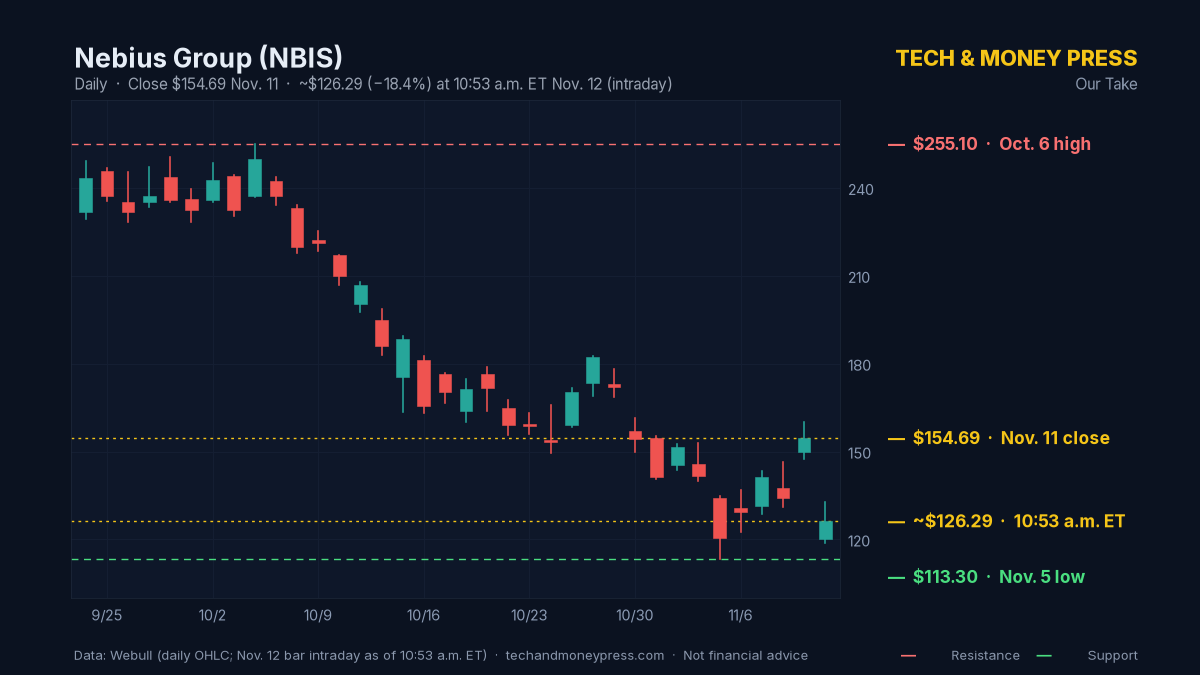
Thursday’s bar is intraday and will change before the 4 p.m. ET close. Webull lists the 52-week range as $73.52 to $299.86.
Key takeaways
- Nebius traded at about $126.29 at 10:53 a.m. ET Thursday, down about 18.4% (Webull).
- Q3 revenue was $980.8 million, up 571% and above the $907.5 million estimate (CNBC, LSEG). About $325 million was non-recurring, the company said.
- 2026 capex rose to about $27 billion; 2027 capex is guided to $40 billion to $45 billion, versus $28.77 billion expected (CNBC, FactSet).
- 2026 revenue is now expected at the low end of $3 billion to $3.4 billion after some partner capacity slipped to the first half of 2027 (Reuters).
- Nebius says prepayments and asset-backed financing will cover 75% to 85% of 2027 spending (Reuters).
- CoreWeave and IREN also fell about 7% to 8% (Webull, 10:53 a.m. ET).
Disclaimer: For news and education only. Not financial advice. Tech & Money Press is not a registered investment advisor. Trading stocks involves risk, including the loss of your investment. Do your own research and consult a licensed professional before making any investment decisions.
Sources: CNBC: Nebius falls 16% as company expects increased 2026 capex spend, issues weak outlook, Nov. 12, 2026. Reuters via CNA: Nebius pares back 2026 revenue forecast on capacity delays, shares slump, Nov. 12, 2026. Nebius Group Q3 2026 earnings call transcript (StockAnalysis). NBIS, CRWV and IREN daily and intraday prices (10:53 a.m. ET, Nov. 12) and 52-week range: Webull.
Featured image: Servers in a data center. Photo: BalticServers.com / Wikimedia Commons, CC BY-SA 3.0.