
Our Take: New AI Chip Rule Targets China’s Remote Access Loophole
By Tech & Money Press · Our Take on U.S. export controls · November 16, 2026
The U.S. Commerce Department on Monday issued a rule that requires a license before advanced AI chips can be used in data centers, anywhere in the world, that rent large amounts of computing power to companies based in China and other restricted countries. Chinese firms were already barred from buying the most advanced Nvidia chips outright. Many got around that by renting computing power in third countries, often in Southeast Asia, which The Washington Post said many in Washington saw as a loophole.
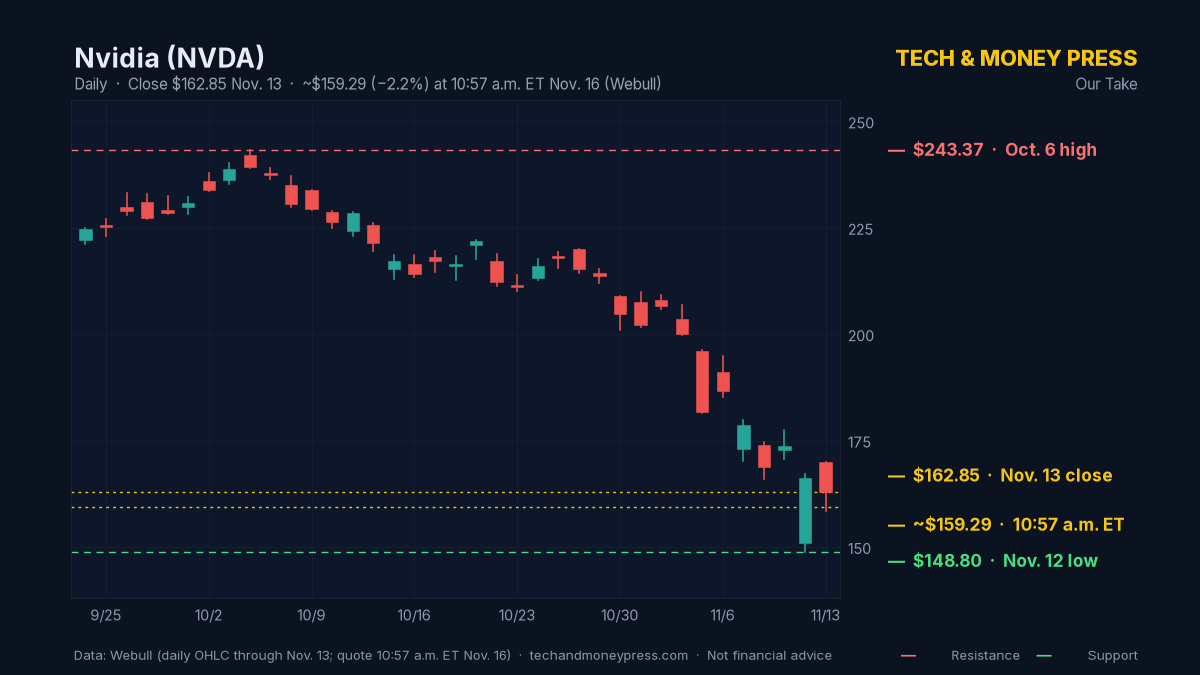
Nvidia (NVDA) traded near $159.29 at 10:57 a.m. ET, down about 2.2% from Friday’s close of $162.85, according to Webull. The VanEck Semiconductor ETF (SMH) was down about 3.7% at the same time.
What the rule does
The Bureau of Industry and Security (BIS) released the measure as an interim final rule. Its press release says it was “written by and at the direction of the Department of Treasury and the National Security Council.” The main pieces, from the rule text and coverage by TechCrunch and Quartz:
- Remote-access license: exporting, re-exporting or transferring advanced chips and servers to a data center now needs a license if that data center, alone or through “linked data centers,” gives more than 12 million “aggregate TPP” of computing power to companies headquartered in Macau or a Country Group D:5 destination, which includes China. TechCrunch estimates that threshold at roughly the power of 750 Nvidia H100 or H200 chips.
- Indirect access counts: the rule covers brokers and go-betweens. Data centers, foreign foundries and chip exporters must check whether customers are owned or controlled, directly or indirectly, from those countries.
- Five new license countries: advanced chips sent to Malaysia, Singapore, Indonesia, Thailand and Brazil now need a license. Commerce said these countries “present a higher-than-normal risk of diversion.” Chips bound for U.S.-headquartered companies are exempt if the exporter meets reporting rules.
- Carve-out: commercial recommender systems, like those used by online retailers and social networks, are excluded.
- Timing: existing operators have 90 days to obtain licenses. The rule takes effect when it is published in the Federal Register, with comments due 60 days later, Quartz reported, citing Bloomberg.
- Old framework gone: it formally rescinds the Biden-era AI Diffusion Rule from January 2025.
Why now
The rule lands four days after Jensen Huang resigned as Nvidia’s CEO. Reports of his relationship with a former executive of Megaspeed, a Singapore-based Nvidia customer that rents out computing power, put the spotlight on whether export controls were working. StockAnalysis noted Megaspeed has bought more than $4 billion of Nvidia chips and equipment, and U.S. officials suspect it of passing chips to Chinese buyers. The Information reported that the relationship allowed more than $7 billion of Nvidia chips to reach Chinese customers, per MarketWatch.
Pressure has also landed on Commerce itself. Treasury Secretary Scott Bessent said Sunday on Fox Business that Nvidia needs “a dramatic shakeup” and pointed to reports that only 1% of chips sold to Singapore stayed there, per MarketWatch. Reuters described the department as “scrambling to show it is cracking down” after reports that it overlooked chip smuggling.
Reuters also flagged the calendar: President Trump meets Chinese President Xi Jinping on Thursday in Shenzhen, site of this week’s APEC summit. Asked about chip sales on Monday, Trump said “selling the other chips is a good thing, not a bad thing,” per CBS News, a reminder that the rule targets only the most advanced chips.
How the market took it
The rule hit an already weak tape. At 10:57 a.m. ET, per Webull, the Invesco QQQ Trust was down about 1.6% and SMH about 3.7%. As of 9:40 a.m. ET, Investopedia reported Intel, Marvell and Micron down more than 6%, AMD and Broadcom down more than 4%, and Nvidia-backed cloud names CoreWeave and Nebius down more than 6%.
Nvidia’s own move was smaller than the group’s. The stock fell more than 12% last week and closed below a $4 trillion market value, per Yahoo Finance. At $159.29 its market value was about $3.84 trillion, per Webull. We covered the overnight Asian sell-off in our chip stocks Our Take this morning.
Our Take
We think the rule matters less for what it bans than for what it signals. What changes is that the burden now sits on everyone in the chain: the chipmaker, the server maker and the data center operator all have to know who the end customer is and who owns it. That is a compliance job, and compliance jobs tend to slow sales at the edges even when the demand is legitimate.
The five-country list is the part to watch. Malaysia, Singapore, Thailand and Indonesia are where many new AI data centers are being built. A license requirement does not mean a ban, and reviews are case by case. But a license takes time, and the 90-day window for existing operators means the first effects could show up in early 2027.
How big is the exposure? Nobody outside the companies knows yet. Nvidia does not break out sales by data center location, and the $4 billion and $7 billion figures tied to Megaspeed come from reporting, not from company filings. That is why Tuesday matters. Analysts will likely ask interim CEO Colette Kress how much of Nvidia’s demand runs through cloud operators in these countries and whether its outlook already assumes tighter rules. Our Nvidia earnings preview lays out what Wall Street expects.
There is also a political layer. The rule was written by Treasury and the National Security Council and released by Commerce, a sign that the White House wants this handled above the department level. With a Trump-Xi meeting on Thursday, it is possible the rule becomes part of a wider negotiation, in either direction. And the leadership question at Nvidia, which we looked at in three questions for anyone considering the Nvidia CEO job, now includes a new one: who manages the company’s relationship with Washington.
Our read: this is a known risk becoming a written rule. The uncertainty shifts from “will they act” to “how strictly will licenses be granted,” and that answer will come over months, not days.
The levels on the chart
Based on Webull data:
- $243.37: the Oct. 6 intraday high, the top of the chart window.
- $162.85: Friday’s Nov. 13 close.
- About $159.29: the quote at 10:57 a.m. ET on Nov. 16.
- $148.80: the Nov. 12 intraday low, the lowest point in the chart window.
What’s next
- Tuesday, Nov. 17: Nvidia fiscal third-quarter results, after the close.
- Wednesday, Nov. 18: minutes of the October Fed meeting.
- Thursday, Nov. 19: Trump meets Xi in Shenzhen during the APEC summit (Reuters); Anthropic’s expected market debut.
- Federal Register publication: starts the rule’s effective date, the 60-day comment period and the 90-day license window.
Key takeaways
- Data centers anywhere now need a license to rent large amounts of AI computing power to China-based companies (BIS rule text).
- The threshold is 12 million TPP, roughly 750 top Nvidia chips (TechCrunch).
- Advanced chip shipments to Malaysia, Singapore, Indonesia, Thailand and Brazil now need licenses, with an exemption for U.S.-headquartered buyers.
- NVDA was near $159.29 at 10:57 a.m. ET, down about 2.2%, while SMH fell about 3.7% (Webull).
- Nvidia reports Tuesday, and Trump meets Xi on Thursday.
Disclaimer: For news and education only. Not financial advice. Tech & Money Press is not a registered investment advisor. Trading stocks involves risk, including the loss of your investment. Do your own research and consult a licensed professional before making any investment decisions.
Sources: BIS: BIS Issues Rule Addressing Remote Access to American Super Intelligence Technology, Nov. 16, 2026. BIS interim final rule text, RIN 0694-AK50. Reuters via Investing.com: US to curb China’s access to AI chips as Trump heads to Asia, Nov. 16, 2026. TechCrunch: US tightens AI chip export controls, Nov. 16, 2026. The Washington Post: Trump administration orders Commerce to close chip loophole, Nov. 16, 2026. CBS News: Commerce Department moves to curb remote access to AI chips, Nov. 16, 2026. MarketWatch via Morningstar: Nvidia’s stock extends declines, Nov. 16, 2026. Quartz: U.S. is closing AI chip cloud loophole, Nov. 16, 2026. StockAnalysis: Commerce closes AI chip remote-access loophole, Nov. 16, 2026. Investopedia: Stock market today, Nov. 16, 2026. Yahoo Finance: Nvidia stock falls as Jensen Huang reportedly weighs CEO comeback, Nov. 16, 2026. Prices and market value: Webull daily data and quotes at 10:57 a.m. ET.