Our Take: Worst Week Since 2020 – Winners, Losers and the AI Unwind
By Tech & Money Press · Our Take on the week in the stock market · November 21, 2026
Wall Street just had its worst week in years. The Dow Jones Industrial Average and the Nasdaq Composite posted their worst weeks since March 2020, and the S&P 500 had its worst week since April 2025, according to CNBC. By Friday’s close, the S&P 500 and the Dow were both more than 10% below their records, which puts them in correction territory. The week’s best performers sold chicken, packaged food and cybersecurity. The worst sold memory chips, AI processors and the parts that connect and power AI data centers.
The short version: Nvidia beat earnings expectations by billions of dollars and its stock still fell about 23% in five days. Anthropic, the largest IPO on record according to the Associated Press, debuted on Thursday, and the broader market fell as soon as it started trading. We covered Thursday on its own in Our Take: Stock Market Sell-Off Sends Dow Down 1,101 Points. This piece covers the full week: the numbers, the sectors, the winners and losers, and what is on the calendar for the short Thanksgiving week.
The Week by the Numbers
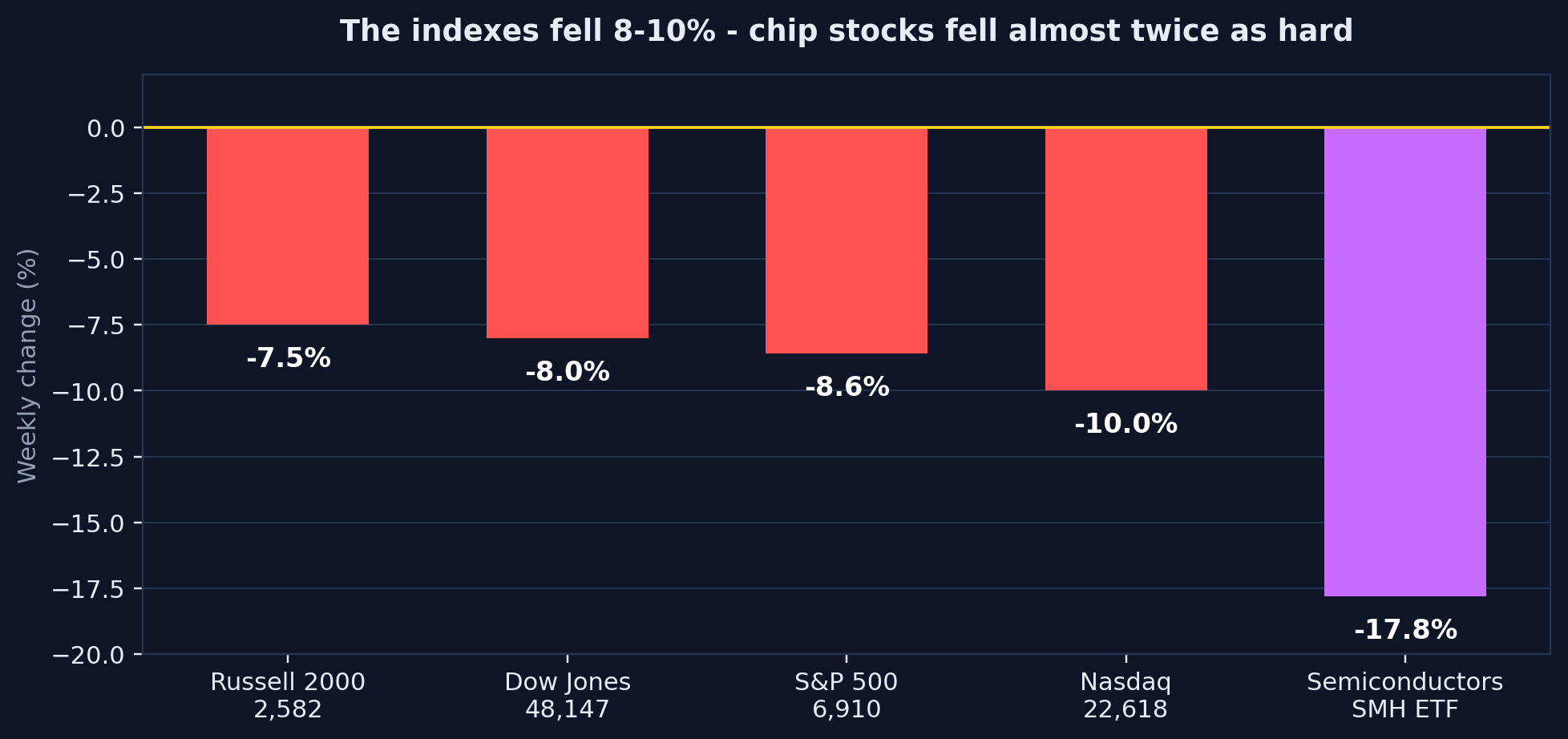
All three major U.S. indexes closed the week sharply lower. Weekly figures are from Seeking Alpha’s “What Moved Markets This Week,” and closing levels are from CNBC:
- Dow Jones Industrial Average: down 8.02% for the week to 48,147.33, its worst week since March 2020.
- S&P 500: down 8.61% to 6,910.39, its worst week since April 2025. It is now more than 10% below its Oct. 6 record, according to the AP.
- Nasdaq Composite: down 10.02% to 22,617.73, its largest one-week percentage drop since the week ending March 20, 2020, according to Dow Jones Market Data. CNBC reported the index is now down 2.7% for 2026.
- Russell 2000: down about 7.5% to 2,582. Small caps fell less than the Nasdaq.
- Cboe Volatility Index (VIX): up 86% for the week to 35.89. The VIX tracks how much traders expect the S&P 500 to move over the next 30 days.
How the Week Ended: Thursday Into Friday
The selling was already heavy before Friday. On Thursday, the Dow fell 1,101.11 points (2.19%) to 49,097.06, its first close below 50,000 since June. The S&P 500 fell 2.02% to 7,175.83 and the Nasdaq fell 2.25% to 23,879.20, according to CNBC. Friday was worse:
| Index | Thursday close | Friday close | Friday | Week |
|---|---|---|---|---|
| S&P 500 | 7,175.83 | 6,910.39 | −3.70% | −8.61% |
| Nasdaq Composite | 23,879.20 | 22,617.73 | −5.28% | −10.02% |
| Dow Jones | 49,097.06 | 48,147.33 | −1.93% | −8.02% |
The Nasdaq-100 fell 5.6% on Friday and briefly traded 20% below its recent high, according to CNBC. Breadth was weak: Trefis counted 375 S&P 500 decliners against 124 gainers on Friday.
A rough Thursday can be about one event, in this case Anthropic’s debut. A Friday that is worse than Thursday, with selling spreading across the market, is what turned a sell-off into a correction.
Every Sector Fell, Tech Fell the Most
All 11 S&P 500 sectors finished the week lower, according to Seeking Alpha, but they did not fall by the same amount. Consumer staples, the most defensive part of the market, lost 2.0%. Information technology lost 12.2%, about six times as much. That gap is the difference between a market that is scared of the whole economy and a market that is unwinding one specific trade.
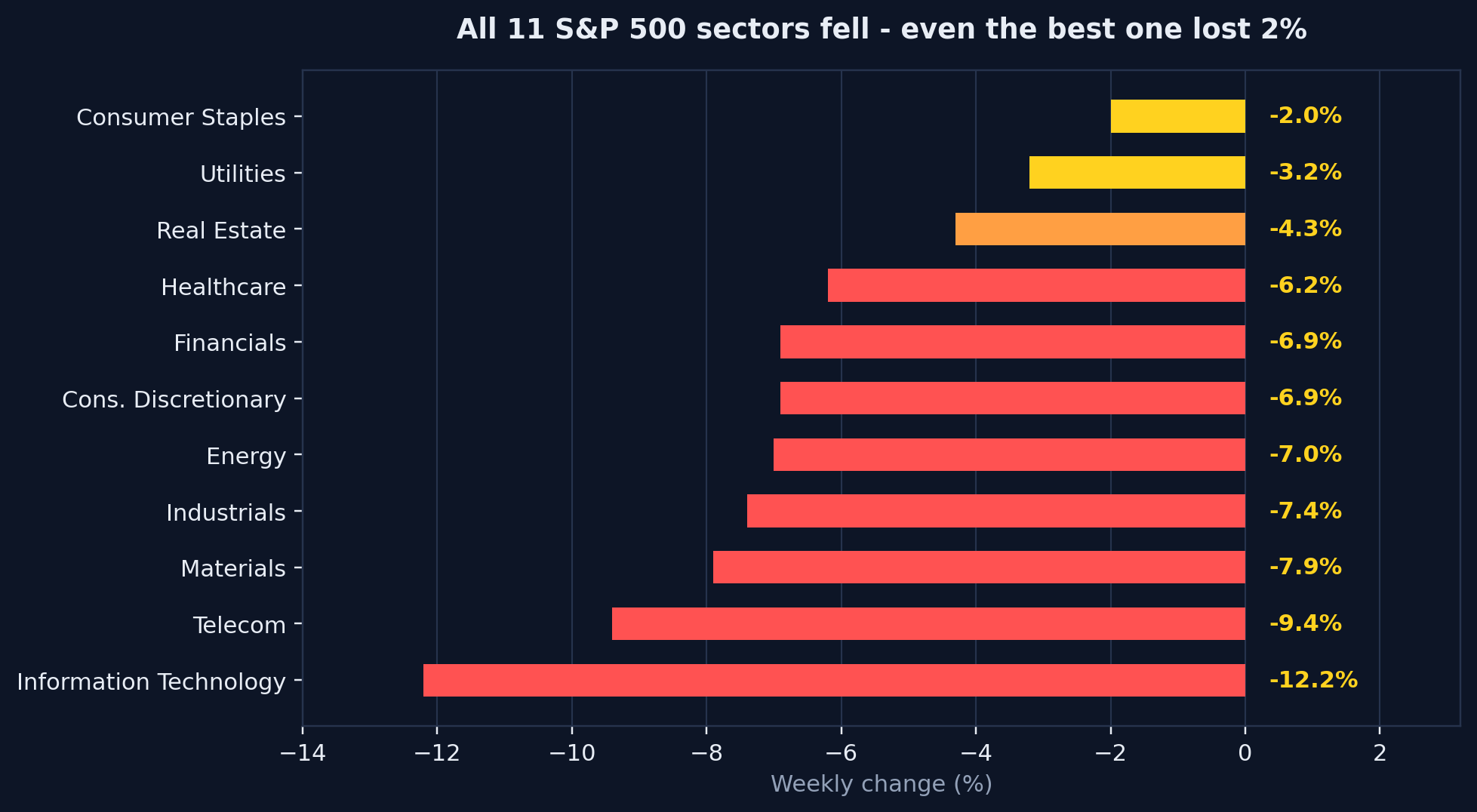
Read from the top down, the sector list looks like a risk ladder. Staples (−2.0%), utilities (−3.2%) and real estate (−4.3%), the dividend-paying corners that often trade like bonds, fell the least. Health care lost 6.2%, financials and consumer discretionary 6.9% each, energy 7.0%, industrials 7.4% and materials 7.9%. Telecom lost 9.4%. Technology, where the AI valuations sit, lost 12.2%.
The Anthropic Debut
Anthropic priced its IPO at $83 a share on Wednesday, above its expected range, and opened on the Nasdaq shortly before noon on Thursday at $111.50, a 34% jump, according to CNBC. It closed its first day at $97.17, up 17% from the IPO price but well below where it opened. On Friday the stock fell 8.5% to $88.91, per Webull, still above its $83 IPO price. We covered the pricing in our Anthropic IPO Our Take.
The major indexes fell to their session lows right after Anthropic began trading on Thursday, as investors appeared to take profits around the long-awaited event, CNBC reported. Interactive Brokers chief strategist Steve Sosnick told CNBC that “the latest round of ‘sell the rally’ trading” had “overtaken the more customary ‘buy the dip’ in recent days,” and said, “The dam seemed to break once the big event was behind us.” Friday’s slide in chip stocks is covered in our chip stocks Our Take.
Nvidia: Strong Earnings, Brutal Week
This is the number that explains the week. On Tuesday, Nvidia reported adjusted earnings of $2.68 a share on revenue of $115.84 billion, up 103% from a year earlier, according to the company. Seeking Alpha said EPS beat estimates by $0.21 and revenue beat by $7.13 billion; LSEG’s consensus was $109.10 billion, according to CNBC. Nvidia also guided to about $130 billion in revenue for the current quarter. Our full breakdown is in our Nvidia earnings Our Take.
The stock still fell 14.0% on Friday to $125.53, per Webull. It lost 22.9% for the week and 40.8% over the past month, according to Trefis. CNBC said it was Nvidia’s longest weekly losing streak since the 2008 financial crisis.
Two problems weighed on the stock alongside the numbers. The first is leadership. Jensen Huang resigned as CEO on Nov. 12, and on Tuesday’s earnings call board chair Harvey Jones said the board “does not intend to reinstate Jensen as CEO.” CFO Colette Kress is serving as interim CEO while the board searches for a permanent chief. The second is regulatory. The Wall Street Journal reported on Tuesday that the SEC was investigating Nvidia, and on Friday Reuters reported, citing two people briefed on the matter, that SEC enforcement staff are looking at potential accounting issues. The SEC declined to comment. Reuters noted that investigations are not evidence of wrongdoing. Separately, CNBC reported that California’s attorney general sent Nvidia an investigative subpoena on Thursday.
Neither issue changes what Nvidia sold last quarter. Both change how much certainty investors want before they pay for next quarter.
Winners of the Week: Food and Firewalls
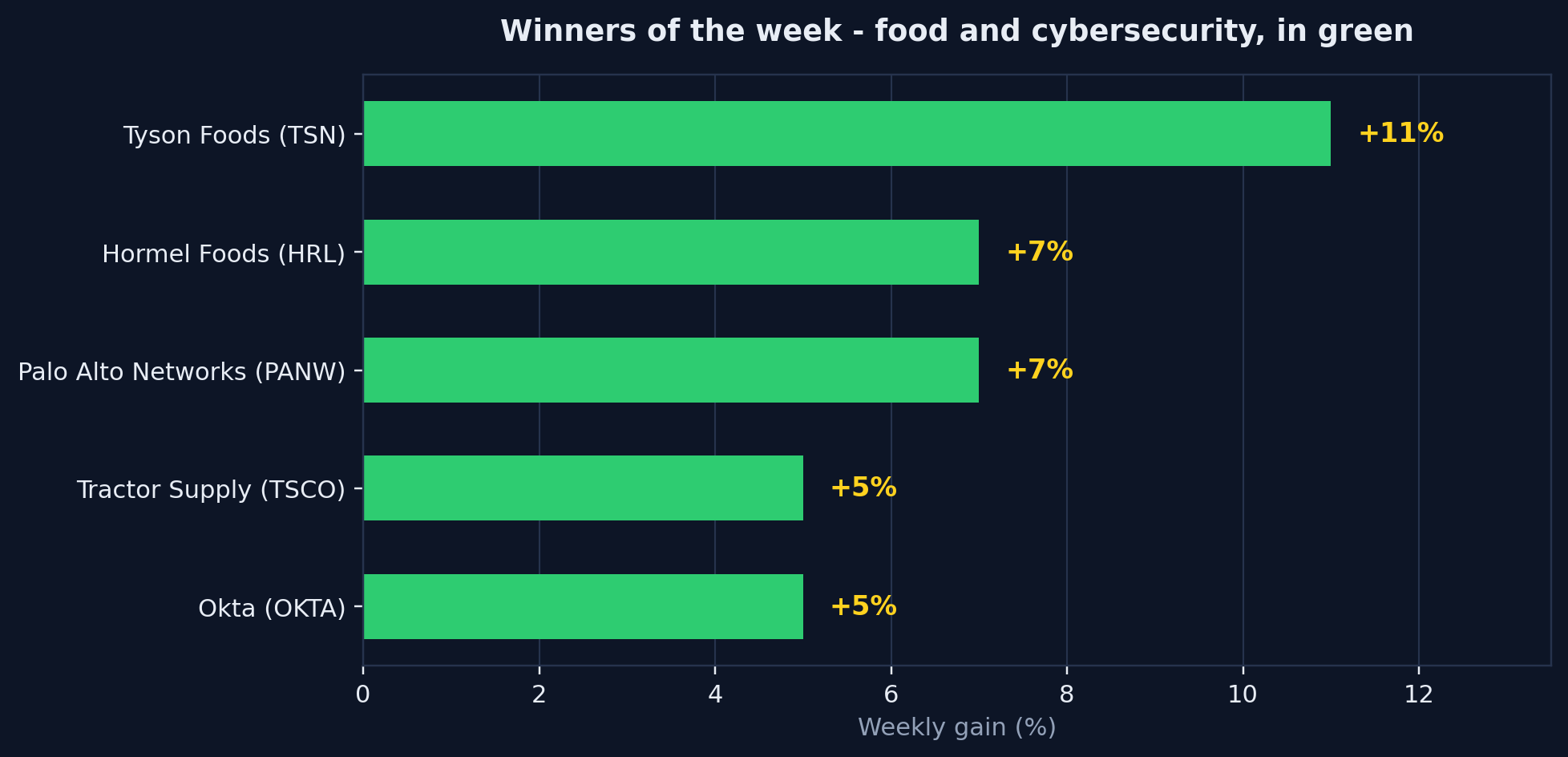
| Ticker | Company | Week | Year to date | Context |
|---|---|---|---|---|
| TSN | Tyson Foods | +10.7% | +14.0% | Food producer, the week’s top S&P 500 gainer |
| HRL | Hormel Foods | +6.6% | +4.8% | Packaged food, a classic defensive name |
| PANW | Palo Alto Networks | +6.5% | +86.4% | Cybersecurity |
| TSCO | Tractor Supply | +5.5% | −21.6% | Rural retailer, far from the AI trade |
| OKTA | Okta | +4.7% | +121.4% | Identity and security software |
What the winners have in common is not growth. Two sell food people buy every week no matter what the Federal Reserve does. Two sell security software that companies cannot easily switch off. One sells to rural customers whose spending has little to do with data centers. In a week when the S&P 500 fell 8.6%, Tyson’s 10.7% gain put it about 19 percentage points ahead of the index.
The year-to-date column adds context. Tractor Supply is still down 21.6% this year even after its strong week, so this was a beaten-down stock getting a bounce, not a new leader. Palo Alto Networks and Okta are the opposite: a strong year and a strong week.
Losers of the Week: One Trade, Five Tickers

| Ticker | Company | Week | Year to date | Context |
|---|---|---|---|---|
| SNDK | SanDisk | −28% | n/a | Memory and storage |
| BE | Bloom Energy | −25.8% | +63.9% | Power for data centers; −15.3% on Friday alone |
| MU | Micron Technology | −23.6% | +108.5% | Memory chips |
| NVDA | Nvidia | −22.9% | −32.5% | AI processors; beat earnings and fell anyway |
| LITE | Lumentum | −22.8% | +24.9% | Optical parts for AI networks |
Every name on this list is tied to the same build-out. SanDisk and Micron make the memory AI systems run on. Lumentum makes optical parts that let AI servers talk to each other. Bloom Energy makes power systems used by data centers. Nvidia designs the processors at the center of it. Owning all five might have looked diversified, but this week they traded like one position.
Several of these are still big winners for the year: Micron is up 108.5% and Bloom Energy 63.9% year to date, even after this week, according to Trefis. That fits a market taking profits on its biggest gainers. Nvidia is the exception, down 32.5% this year, with leadership and regulatory questions the others do not have.
Friday’s Movers
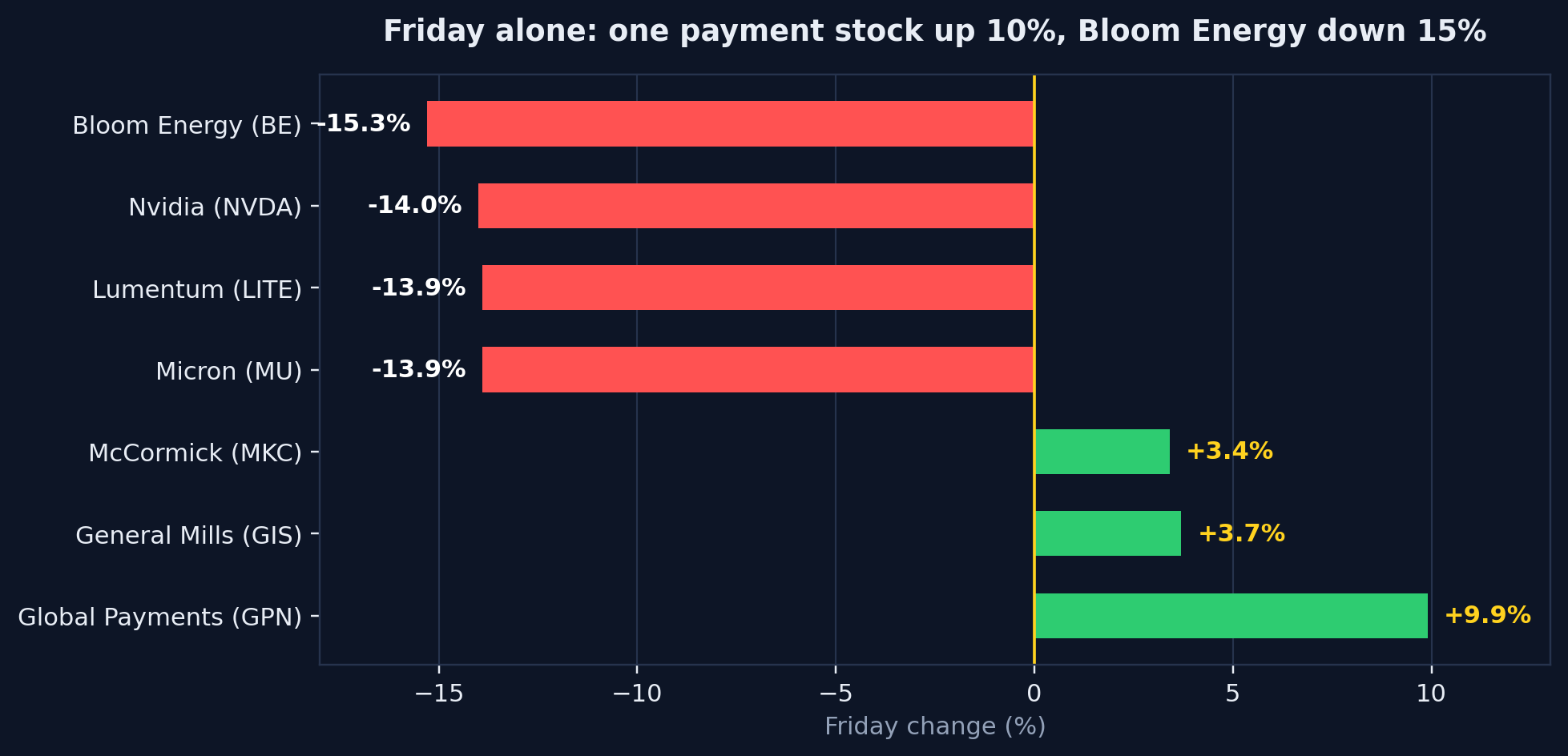
Friday’s single-day list from Trefis shows the split in one session. The day’s best S&P 500 stock was Global Payments, up 9.9%, followed by General Mills (+3.7%) and McCormick (+3.4%). The worst were the same AI names that led the week down: Bloom Energy −15.3%, Nvidia −14.0%, and Lumentum and Micron −13.9% each. Money was not leaving the market completely on Friday. It was moving between different kinds of stocks. CNBC also noted gains in Walmart, Costco, Johnson & Johnson and Procter & Gamble.
The S&P 500 also stayed below its 200-day moving average, a widely followed gauge of the longer-term trend. On Thursday, Thomas Martin of Globalt Investments told CNBC that a break below the average is “a big technical signal” for trend followers. The 200-day average describes the trend; it does not predict what comes next.
Rates, Crypto and the Rest of the World
Yields and the Fed
The sell-off was not only about AI. Investors are also weighing the chance of another Fed rate hike. CME Group’s FedWatch tool showed a 98.7% probability of a hike at the Fed’s Dec. 8-9 meeting as of Friday morning, according to Benzinga. Minutes from the October meeting showed almost all officials expected more increases, as we explained in our Fed minutes Our Take. Treasuries rallied on Friday as investors looked for safety, and the 10-year yield ended the week at 4.912%, per Seeking Alpha. Higher rates make future profits worth less today, which tends to hit highly valued growth stocks the hardest.
Crypto took the same hit
Bitcoin fell 10.3% for the week, according to Seeking Alpha, and on Friday dropped below $60,000 for the first time since July, according to CNBC. Ethereum fell 8.8% and Litecoin 13.2% for the week. We covered the move in our Bitcoin Our Take. This week crypto did not protect stock portfolios. It traded like the riskiest part of the same tech trade.
Around the world
The selling was global, but it was not the same everywhere. Japan fell 7.7%, Germany 7.3%, France 5.3%, Hong Kong 5.2% and London 5.1%. China lost a smaller 2.8%, and India rose 2.9%, the week’s one major market in the green, according to Seeking Alpha. In commodities, gold fell 8.9% to about $3,539 an ounce and natural gas rose 7.3%. Gold falling in a fearful week is worth noting: when investors need cash, they often sell what they can, not only what they want to.
So what was this week? It was an AI unwind with a rates problem on top. On this evidence, it was not a verdict that the whole economy is rolling over. A recession scare does not usually leave cybersecurity stocks up 7%, send a payments stock up 10% on the worst day, and lift India at the same time.
What’s on the Calendar Next Week
Next week is short. U.S. stock markets are closed Thursday, Nov. 26, for Thanksgiving, and the NYSE closes early at 1:00 p.m. ET on Friday, Nov. 27. Here is what is scheduled, according to CNBC’s week-ahead calendar:
- Wednesday, Nov. 25 data: October PCE inflation, the Fed’s preferred inflation gauge, along with the second estimate of third-quarter GDP, weekly jobless claims and durable goods orders, all at 8:30 a.m. ET.
- Earnings: Dell Technologies, Workday, HP, Autodesk, Analog Devices, Best Buy and Dollar Tree report on Tuesday, and Deere reports on Wednesday. Dell is the most closely tied to this week’s story because it sells the servers used to build AI data centers.
- Nvidia news: any new detail on the reported SEC inquiry or the CEO search could affect the whole AI group.
- Anthropic’s first full week: how the newest AI stock trades will be closely followed as a read on investor appetite for AI.
- Volatility: the VIX ended the week at 35.89. Whether it eases or stays high will show how much protection traders are still paying for.
Our Take
This week looked less like a reaction to one piece of bad news and more like a market that had been looking for a reason to take profits and then got several at once. Anthropic’s debut was the most visible AI event of the year, and the selling picked up as soon as it arrived. Nvidia beat estimates by billions and fell anyway, with no permanent CEO and a reported SEC accounting probe. On top of that, FedWatch showed a December rate hike as almost certain.
What we take from it is narrower than the headlines. The economy did not get 10% worse in five days, and Tyson Foods did not get 11% better at selling chicken. What changed was the price of certainty. All year, investors paid for AI growth as if it were guaranteed. This week they started charging for the risk that it is only likely, and many of the stocks that had run the furthest, like Micron, up 108.5% this year, gave back the most.
Key Takeaways
- The Dow fell 8.02% and the Nasdaq 10.02%, their worst weeks since March 2020. The S&P 500 fell 8.61%, its worst week since April 2025, and entered correction territory (Seeking Alpha, CNBC).
- All 11 S&P 500 sectors fell, from consumer staples (−2.0%) to information technology (−12.2%) (Seeking Alpha).
- Top S&P 500 gainers: Tyson Foods, Hormel, Palo Alto Networks, Tractor Supply and Okta. Top decliners: SanDisk, Bloom Energy, Micron, Nvidia and Lumentum (Seeking Alpha, Trefis).
- Nvidia beat estimates with EPS of $2.68 and revenue of $115.84 billion, then fell 14.0% on Friday to $125.53 after Reuters reported an SEC focus on its accounting (Nvidia, CNBC, Reuters, Webull).
- Anthropic opened at $111.50 after pricing at $83, closed its first day at $97.17 and ended Friday at $88.91 (CNBC, Webull).
- The VIX rose 86% to 35.89, Bitcoin fell 10.3% and the 10-year yield ended the week at 4.912% (Seeking Alpha).
Sources: Seeking Alpha, “What Moved Markets This Week,” Nov. 21, 2026. CNBC, “S&P 500 and Dow close in correction; Nasdaq erases 2026 gain as AI rout picks up steam,” Nov. 20, 2026; “Dow closes below 50,000; Nasdaq falls 2% as Anthropic IPO fails to resuscitate AI trade,” Nov. 19, 2026; “Nvidia (NVDA) Q3 2027 earnings report,” Nov. 17, 2026; “Stock market next week: Outlook for Nov. 23-27, 2026,” Nov. 20, 2026. Associated Press, “S&P 500 sinks 3.7% and the Nasdaq composite goes negative for the year,” Nov. 20, 2026, and “Anthropic pulled off the biggest IPO ever.” Dow Jones Market Data via Morningstar, Nov. 20, 2026. Nvidia, “NVIDIA Announces Financial Results for Third Quarter Fiscal 2027,” Nov. 17, 2026. Reuters, “Nvidia’s accounting is a focus of US SEC investigation, sources say,” Nov. 20, 2026. Trefis, “S&P 500 Movers,” Nov. 21, 2026. Benzinga, Nov. 20, 2026 (FedWatch odds). Prices for Anthropic, Nvidia and the SMH ETF: Webull daily data.
Disclaimer: For news and education only. Not financial advice. Tech & Money Press is not a registered investment advisor. Trading stocks involves risk, including the loss of your investment. Do your own research and consult a licensed professional before making any investment decisions.
Featured image: “Nasdaq MarketSite in Times Square, New York” by Luca Marfè at Italia all’ONU, via Wikimedia Commons, licensed under CC BY 2.0. Charts: Tech & Money Press.