Our Take: Cisco Stock Slips After a Record Q1 as Margins Narrow
By Tech & Money Press · Our Take on Cisco Q1 fiscal 2027 earnings · November 13, 2026
Cisco just posted its fastest growth in more than 15 years, and the stock is lower anyway. Cisco Systems (CSCO) was quoted at about $99.34 in premarket trading at 6:55 a.m. ET Friday, down about 2.6% from Thursday’s close of $102.01, according to Webull data. On Thursday evening, right after the report, the shares had been up 1.85% at $103.90 in after-hours trading, Benzinga reported.
The numbers were strong on almost every line. Revenue rose 24%, earnings beat, and Cisco raised its full-year outlook and its target for AI revenue from the big cloud companies. What the market seems to be focusing on is the cost of that growth: gross margins fell as more of Cisco’s sales came from AI networking hardware.
What Cisco reported
For the first quarter of fiscal 2027, which ended Oct. 24, Cisco reported, per its press release and CNBC:
- Revenue: $18.5 billion, up 24% from $14.88 billion a year earlier. LSEG’s consensus was $18.1 billion.
- Adjusted EPS: $1.40, up 40%, versus $1.33 expected (LSEG).
- GAAP net income: $4.6 billion, or $1.14 per share, up from $2.9 billion, or 72 cents, a year ago.
- Product revenue: up 32%. Services revenue rose just 1%.
- Networking: up 43%. Security rose 7%, Collaboration 8% and Observability 2%.
- Operating cash flow: $4.4 billion, up 36%.
- Remaining performance obligations: $46.2 billion, up 8%.
Growth was broad by region, too: the Americas rose 28%, EMEA 18% and Asia-Pacific, Japan and China 21%, the company said.
“In Q1, we delivered the strongest revenue and non-GAAP earnings per share growth rates for Cisco in over 15 years,” CEO Chuck Robbins said in the release. “We are in the very early stages of a multi-year networking supercycle.”
Cisco also returned $3.7 billion to shareholders in the quarter. It paid a dividend of $0.42 per share ($1.7 billion) and bought back about 18 million shares for $2.0 billion, at an average price of $112.38, according to the release. It declared another $0.42 quarterly dividend, payable Jan. 20, 2027.
The guidance raise
The outlook was the other strong point. According to Benzinga and CNBC:
- Fiscal Q2 revenue: $18.0 billion to $18.2 billion, versus $17.88 billion expected (LSEG).
- Fiscal Q2 adjusted EPS: $1.34 to $1.36, versus $1.23 expected.
- Fiscal 2027 revenue: raised to $74.8 billion to $75.8 billion, from $72.2 billion to $73.4 billion. Analysts expected $73.02 billion.
- Fiscal 2027 adjusted EPS: raised to $5.47 to $5.53, from $5.05 to $5.11.
Cisco also raised its expectation for AI infrastructure revenue from hyperscalers to $9 billion this fiscal year, more than double the fiscal 2026 total. By our math, that would be about 12% of the midpoint of the new full-year revenue range. That is a big change for a company CNBC described as trying to catch up after missing the early years of the generative AI boom.
In our Cisco earnings preview, we said EPS, margins and guidance would decide the reaction. EPS and guidance cleared the bar easily. Margins are the part investors are debating.
The margin question
Here is the trade-off, straight from Cisco’s release. On an adjusted (non-GAAP) basis:
- Total gross margin: 65.6%, down from 68.1% a year earlier, a drop of 2.5 percentage points.
- Product gross margin: 63.7%, down from 67.2%.
- Services gross margin: 72.9%, up from 70.7%.
Investing.com reported that the pressure came from a heavier mix of lower-margin AI networking hardware and higher memory component costs. It also reported that CFO Mark Patterson said full-year adjusted gross margin should stay just below 65% while hardware volumes remain high.
That is the classic hardware dilemma. Selling much more equipment to hyperscalers grows revenue fast, but each dollar of that equipment carries a lower margin than Cisco’s software and services. Services, Cisco’s highest-margin line, grew only 1%.
Still, the margin squeeze did not stop profits from rising faster than sales. Adjusted operating income was $7.0 billion, up 37%, and the adjusted operating margin was 37.8%, because adjusted operating expenses rose only 2%. In plain terms, Cisco is earning less on each product it sells but spreading its costs over a much bigger base.
Why the stock is lower
The premarket drop looks less like a verdict on the quarter and more like a reaction to high expectations. According to CNBC, Cisco shares were up about 35% this year as of Thursday’s close, against about 9% for the Nasdaq. When a stock has already run, a beat-and-raise can be partly priced in.
Investing.com also pointed to a Morgan Stanley downgrade on Nov. 5 to Equal-Weight from Overweight. The analyst argued that much of the AI story was already reflected in the price and that some demand may have been pulled forward ahead of Cisco’s price increases.
The backdrop is shaky, too. AI infrastructure stocks have been volatile this week, from the Nvidia leadership turmoil to the selling in neoclouds after Nebius’s capex jump. The debate in that group, as in our CoreWeave Our Take, has been about how much the AI build-out costs. Cisco is on the other side of that spending: it is one of the suppliers getting paid.
Our Take
We think this was a strong quarter with one real weak spot. The demand picture is hard to argue with: networking up 43%, every region growing by double digits, a guidance raise well above estimates and an AI target that more than doubles. Cisco is finally getting a meaningful share of hyperscaler spending.
The weak spot is margins. A 2.5-point drop in gross margin is significant for a company that investors have valued partly for its steady, high-margin profile. If hardware keeps growing much faster than services, Cisco’s mix will keep shifting toward lower-margin sales. The CFO’s comment that full-year gross margin should sit just below 65% suggests this is not a one-quarter blip.
So the market is weighing two versions of Cisco: a faster-growing AI hardware supplier with thinner margins, or the steadier software-and-services story of the past decade. This report points to the first. Our view is that the next few quarters will be judged on whether earnings keep growing faster than revenue, as they did this quarter, even as margins slip. Services growth and memory costs are the two lines we would watch.
The levels on the chart
These are the reference points on Cisco’s daily chart, based on Webull data:
- $118.65: the Oct. 9 intraday high, the top of the chart window.
- $102.01: Thursday’s close, before the earnings release.
- About $99.34: Friday’s premarket quote at 6:55 a.m. ET.
- $93.35: the Nov. 6 intraday low, the lowest point in the chart window.
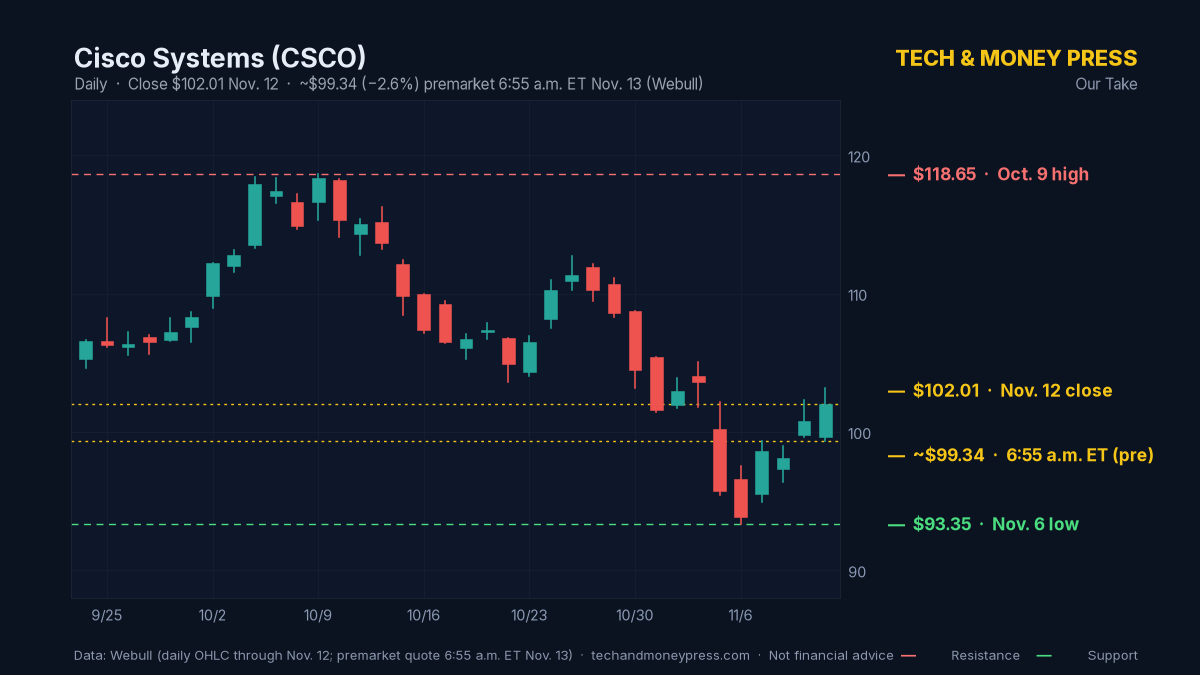
Premarket trading is thin and prices can change a lot before the 9:30 a.m. ET open. Thursday’s close was about 14% below the Oct. 9 high, by our math.
Key takeaways
- Cisco was quoted at about $99.34 premarket at 6:55 a.m. ET Friday, down about 2.6% from Thursday’s $102.01 close (Webull).
- Q1 revenue was $18.5 billion, up 24%, and adjusted EPS was $1.40, both above LSEG estimates (CNBC).
- Networking revenue rose 43%; services rose 1% (Cisco).
- Fiscal 2027 revenue guidance was raised to $74.8 billion to $75.8 billion, and the hyperscaler AI infrastructure target to $9 billion (Cisco, Benzinga).
- Adjusted gross margin fell to 65.6% from 68.1% as AI hardware and memory costs weighed (Cisco, Investing.com).
- The stock was up about 35% this year before the report (CNBC).
Disclaimer: For news and education only. Not financial advice. Tech & Money Press is not a registered investment advisor. Trading stocks involves risk, including the loss of your investment. Do your own research and consult a licensed professional before making any investment decisions.
Sources: Cisco: Cisco Reports First Quarter Earnings, Nov. 12, 2026. CNBC: Cisco beats on earnings, says AI infrastructure revenue will double this fiscal year, Nov. 12, 2026. Benzinga: Cisco tops Q1 estimates, raises FY27 outlook during multi-year networking ‘supercycle’, Nov. 12, 2026. Investing.com: Why is Cisco stock sliding today?, Nov. 13, 2026. CSCO daily prices and premarket quote (6:55 a.m. ET, Nov. 13): Webull.
Featured image: Rack-mounted Ethernet switches and patch panels. Photo: Dsimic / Wikimedia Commons, CC BY-SA 4.0.