Our Take: Broadcom Stock Falls After Redburn Downgrade on AI Funding Risk
By Tech & Money Press · Our Take on Broadcom and the Rothschild & Co Redburn downgrade · November 13, 2026
Broadcom has been one of the biggest winners of the AI build-out, and it just had a very strong week. On Friday, one analyst asked the question many investors have been circling: who pays for all of this?
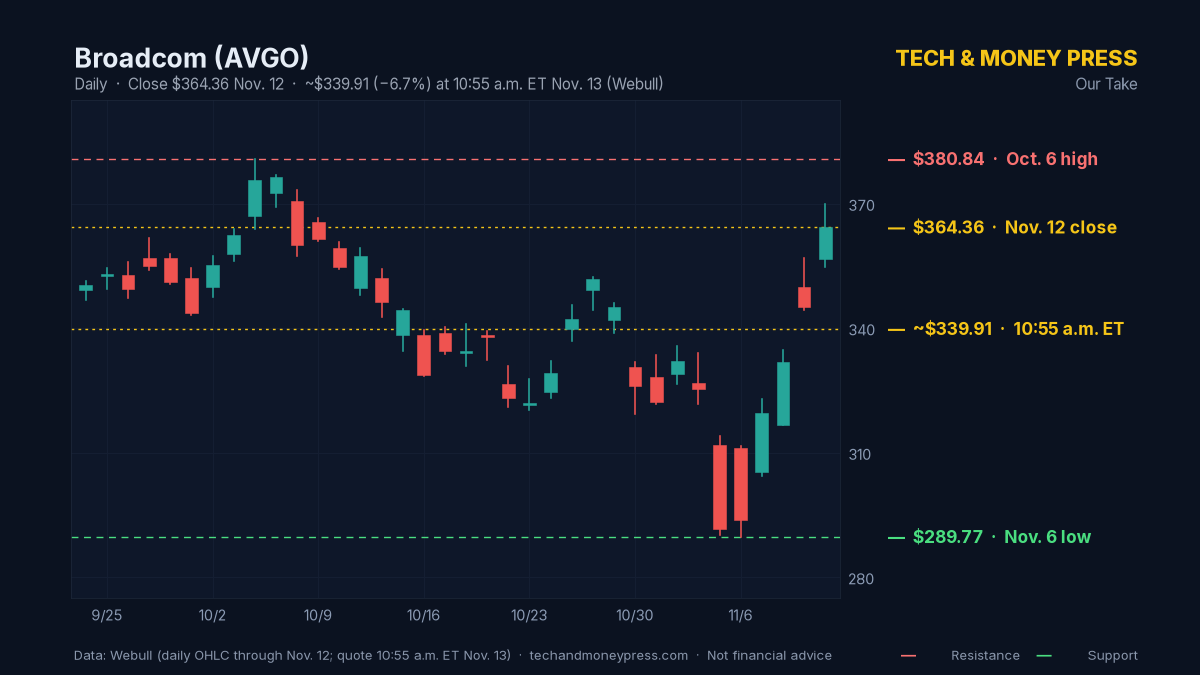
Broadcom (AVGO) was trading near $339.91 at 10:55 a.m. ET, down about 6.7% from Thursday’s close of $364.36, according to Webull data. The drop followed a downgrade from Rothschild & Co Redburn and came on a day when chip stocks were broadly lower.
What Redburn said
Analyst Mike Harrison cut Broadcom to Neutral from Buy and lowered his price target to $398 from $595, according to Investing.com and TipRanks/The Fly. His main points:
- Valuation is not the issue on its own. Broadcom’s guidance implies the stock trades at about 11 times fiscal 2028 earnings, but Harrison said that “counts for little when both the quality and the durability of earnings are under scrutiny.”
- The customer concentration is. Up to 15 gigawatts of computing capacity for Anthropic and OpenAI underpins Broadcom’s $230 billion fiscal 2028 AI revenue guidance, Investing.com reported. Those labs “need to establish sustained primacy over open models and become self-financing in short order,” Harrison wrote.
- Funding is a risk. Both labs rely heavily on access to credit markets. Investment-grade credit ratings would help and could reduce the need for Broadcom’s backstops, Redburn said, but the build-outs remain exposed to stress elsewhere in the AI ecosystem.
- Competition is shifting. Falling inference costs threaten the labs’ lead over open models, and competitive pressure will likely push inference margins lower, Harrison said. He also flagged Google’s in-house chip design efforts as something the market needs reassurance on.
Redburn also changed how it values the stock, moving to a sum-of-the-parts model and saying that “strong earnings momentum is a better predictor of outperformance than low valuation multiples for tech companies.”
The context: a fast rally into the downgrade
The downgrade landed after a sharp run. Investing.com said the stock had gained about 24% over the past week before Friday. Based on Webull data, Broadcom fell to an intraday low of $289.77 on Nov. 6 and closed at $364.36 on Nov. 12, a rise of roughly 26% by our math.
The business itself has been growing quickly. MarketBeat reported that Broadcom’s most recent quarter delivered adjusted EPS of $3.32 versus $3.22 expected and revenue of $29.59 billion, up 85.5% from a year earlier. Most analysts remain positive: MarketBeat counts a consensus “Moderate Buy” rating.
Friday’s drop was also not only about Broadcom. Investopedia reported Advanced Micro Devices down about 5% and the iShares Semiconductor ETF (SOXX) down about 2% in early trading, as the fallout from Jensen Huang’s exit at Nvidia and a 10-year Treasury yield above 5.1% weighed on chip stocks.
Our Take
We think the Redburn note matters less for its rating and more for the question it puts on the table. The AI trade has mostly been debated as a demand story: are companies still spending? Results from Applied Materials and Cisco this week suggest they are. Redburn’s point is that demand is only as solid as the balance sheets behind it.
For Broadcom, that is a concentrated bet. A large part of its long-term AI guidance depends on two private companies, Anthropic and OpenAI, that are still raising huge amounts of money to fund computing. We looked at how big those valuations have become in our take on Anthropic’s IPO plans. If those labs keep growing revenue and win investment-grade ratings, the risk shrinks. If funding gets harder, as rising bond yields could make it, suppliers like Broadcom feel it.
The other open question is competition among chip designers. Custom chips, Broadcom’s specialty, are attractive to big customers because they lower costs. But the same logic pushes customers like Google to bring more design work in-house.
The next big read on AI spending comes Tuesday, when Nvidia reports earnings. We covered what to listen for on that call.
The levels on the chart
Based on Webull data, these are the reference points on the daily chart:
- $380.84: the Oct. 6 intraday high, the top of the chart window.
- $364.36: Thursday’s close, before the downgrade.
- About $339.91: the regular-session quote at 10:55 a.m. ET on Nov. 13.
- $289.77: the Nov. 6 intraday low, the lowest point in the chart window.
Key takeaways
- Rothschild & Co Redburn downgraded Broadcom to Neutral from Buy (Investing.com, TipRanks/The Fly).
- The firm cited AI lab financing, customer concentration in Anthropic and OpenAI, open-model competition and Google’s in-house chip efforts.
- Broadcom’s $230 billion fiscal 2028 AI revenue guidance rests on up to 15 GW of compute for Anthropic and OpenAI (Investing.com).
- The stock had gained about 24% over the past week before Friday (Investing.com).
- AVGO was near $339.91 at 10:55 a.m. ET, down about 6.7% from $364.36 (Webull).
Disclaimer: For news and education only. Not financial advice. Tech & Money Press is not a registered investment advisor. Trading stocks involves risk, including the loss of your investment. Do your own research and consult a licensed professional before making any investment decisions.
Sources: Investing.com: Rothschild downgrades Broadcom stock rating on AI financing concerns, Nov. 13, 2026. Investing.com: Redburn lowers Broadcom to Neutral on limited re-rating potential, Nov. 13, 2026. TipRanks/The Fly: Broadcom downgraded to Neutral from Buy at Rothschild & Co Redburn. MarketBeat: Broadcom stock gets downgrade from Rothschild & Co Redburn. Investopedia: Stock market today, Nov. 13, 2026. AVGO daily prices and 10:55 a.m. ET quote: Webull.
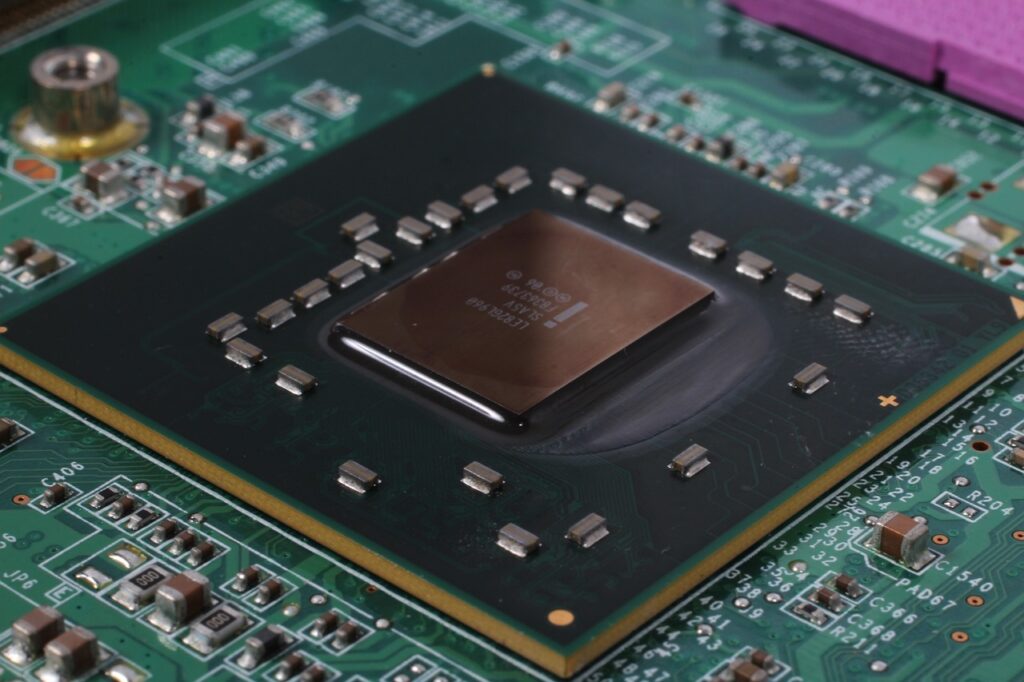
Featured image: Processor chip on a circuit board. Photo: V0yager / Pixabay.